
ONE VISIT. ONE EVALUATION. TWO PAYMENTS.
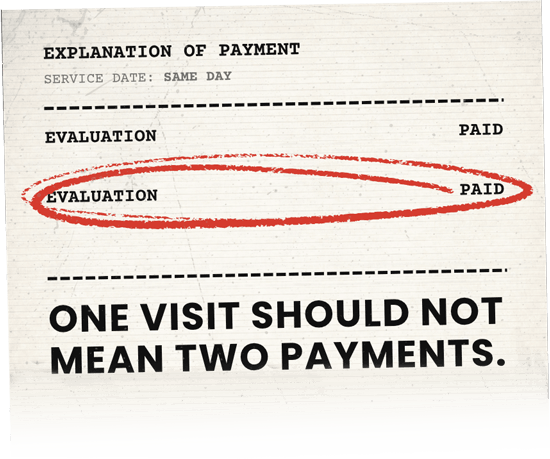
TELL LAWMAKERS TO HELP STOP HEALTHCARE DOUBLE BILLING.
One visit. One Evaluation. Two Payments.
TWO SERVICES. ONE APPOINTMENT. OVERLAPPING PAYMENT.
Picture a routine visit to a dermatologist for a mole check. The doctor reviews the patientʼs health history and examines the mole. During that same appointment, the doctor decides to remove it as an outpatient procedure.
The office visit and the procedure are separate services. But part of the patient-evaluation work may overlap and payment for that work is already built into the procedure. Under current Medicare rules, both services can still be paid at close to full price.
That means Medicare may pay twice for overlapping evaluation work during a single encounter. That is healthcare double billing.
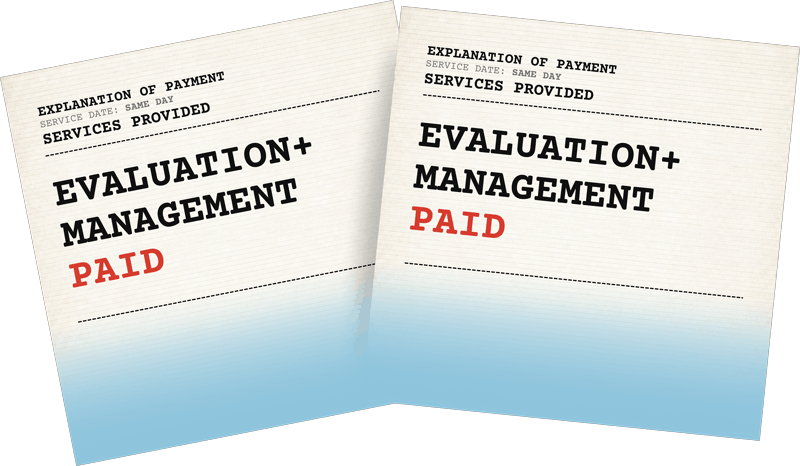
| SAME-DAY CLAIM | PAYMENT |
|---|---|
| Office visit / evaluation | PAID |
| Outpatient procedure, including related evaluation work | PAID |
| Overlapping evaluation work | PAID AGAIN? |
“We are likely duplicating payment under the current payment methodology.”
— Centers for Medicare & Medicaid Services
DOUBLE BILLING IS ONE REASON HEALTHCARE COSTS KEEP RISING.
A second payment may look like one line on one claim. Across the healthcare system, unnecessary payments add to total spending. Higher healthcare spending is one of the forces that contributes to higher premiums and out-of-pocket costs for everyone—including patients, families, employers, and taxpayers.
Double billing is not the only cause of high healthcare costs but it is a contributing factor that can be identified and addressed.
- THE SECOND PAYMENT
Overlapping work receives an additional payment. - HIGHER TOTAL SPENDING
Unnecessary payments accumulate across the healthcare system. - HIGHER COSTS FOR EVERYONE
Rising spending contributes to higher premiums and out-of-pocket costs.

FEDERAL WATCHDOGS HAVE FOUND THE PATTERN.

42% BILLED WITH A SAME-DAY OFFICE VISIT
A 2025 federal audit of eye injections found that 42% were billed with a same-day office visit using this billing pattern. Investigators reported that 92% of the reviewed office-visit claims did not meet Medicareʼs documentation standard. The pattern cost Medicare $124 million in one year.
Source: HHS Office of Inspector General, May 2025
$62.9 MILLION IN ESTIMATED OVERPAYMENTS
A separate federal audit of the same billing pattern in dermatology estimated that Medicare overpaid $62.9 million on claims that did not meet requirements.
Source: HHS Office of Inspector General, November 2025
ALMOST $50—THEN ANOTHER CHARGE
An evaluation and management fee can exceed $235. Under traditional Medicare Part Bʼs 20% coinsurance model, a patientʼs share for the office-visit charge can approach $50. When an additional payment is attached to the same encounter, patients can face additional out-of-pocket cost.
Source: CMS Fee Schedule
HIGHER COSTS CAN FORCE IMPOSSIBLE CHOICES.
For people already managing fixed incomes, medical debt, and rising household costs, another healthcare charge is real money. High costs can lead people to delay or skip care—putting both financial security and health at risk.
- 57% of American seniors get by on less than $2,000 a month. [The Senior Citizens League, 2025]
- 22% of adults 65 and older carry medical or dental debt. [KFF, 2022]
- 15% of seniors—9.2 million people—live in poverty under a measure accounting for out-of-pocket medical costs. [US Census Bureau, 2024]
THESE ARE AMONG THE HIGHEST-PAID SPECIALTIES IN MEDICINE.
Patients are being asked to absorb rising premiums and out-of-pocket costs. Meanwhile, several of the physician specialties with high volumes of same-day visits and procedures report average annual compensation near or above half a million dollars.
- Orthopedic surgery: $696,852
- Otolaryngology "ENT": $549,810
- Dermatology: $497,509
- Ophthalmology: $487,438

Across these four specialties, average annual compensation is approximately $558,000.
Physicians should be paid fairly for the care they provide. But fair payment does not require paying twice for overlapping work. When seniors are skipping care and families are struggling with healthcare bills, protecting patients from unnecessary costs should come before preserving duplicate payments for some of medicineʼs highest-paid specialties.
Source: Doximity Physician Compensation Report 2026. Figures represent average annual compensation, not base salary alone.
PAY FOR THE CARE. STOP PAYING FULL PRICE TWICE.
CMS has proposed changing payment when an office visit and a procedure are billed on the same day. Under the proposal, the most expensive service would be paid at 100%, while the other same-day service would be paid at 50%.
The most valuable service is still paid in full. The policy reduces payment for work that may overlap.
| TODAY | UNDER CMS PROPOSAL | |
|---|---|---|
| Procedure | $300 | $300 |
| Office visit | About $237 | About $118 |
| Combined payment | About $537 | About $418 |